
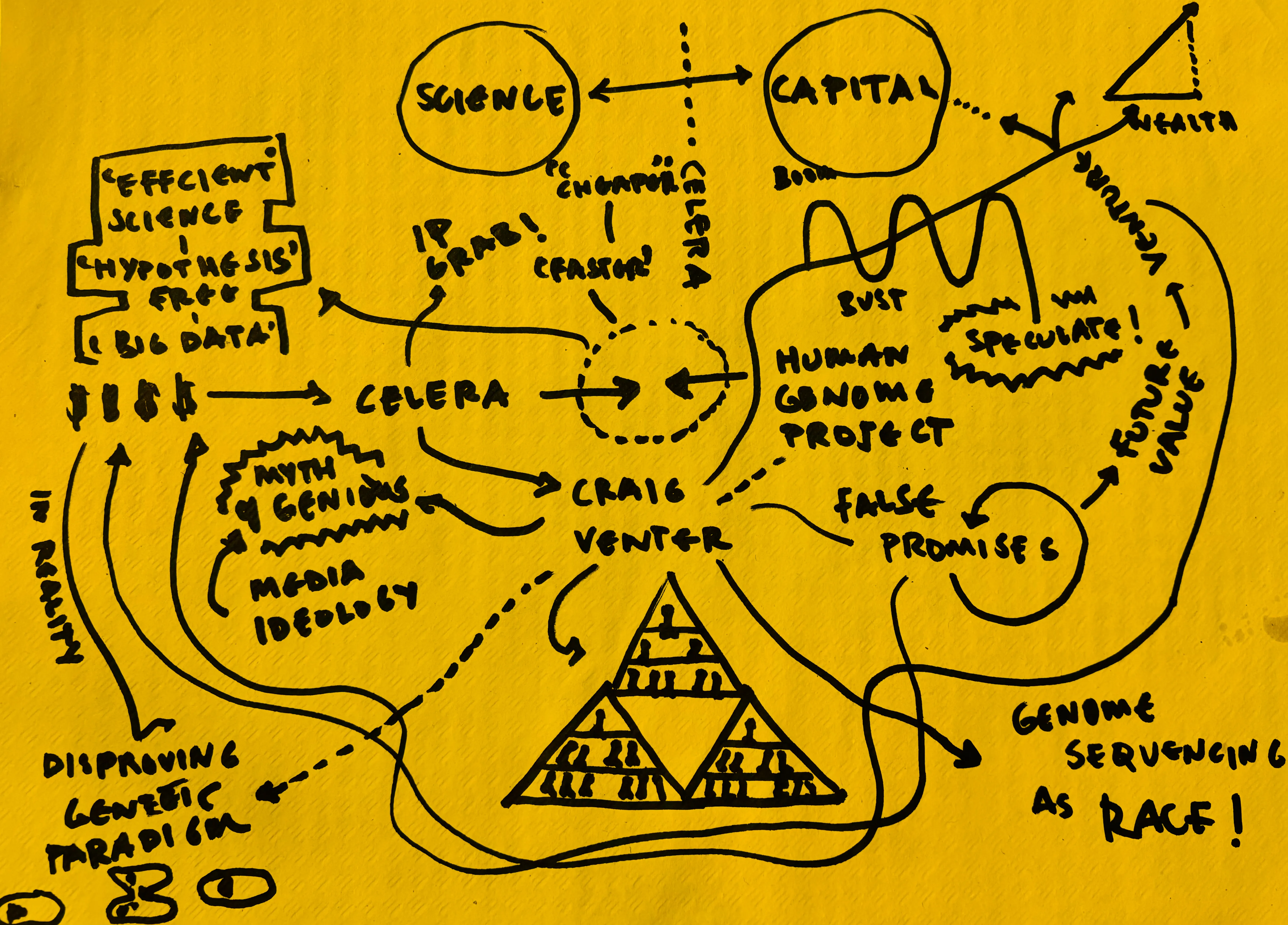

Life scientist and entrepreneur J. Craig Venter recently passed away, so out of respect, I won’t repeat the things his colleagues said about him while he was alive. While his work and his professional and public persona tended to attract disdain and outright hostility from fellow scientists, the press feasted on this controversy throughout his life, elevating his profile and frequently celebrating Venter himself.
Maynard Olson, a participant in the public Human Genome Project (HGP), described this dynamic well when recalling the press’s response to the launch of Celera, the private corporation of which Venter was CEO (named for the speed with which it planned to “race” the HGP): “A key ally [of Venter’s] proved to be the New York Times reporter Nicholas Wade. Wade […] became such an uncritical component of Celera’s public-relations campaign that there was often little distinction between front-page stories in the Times and unfiltered corporate press releases.”1
Venter’s death has not changed this pattern. Obituaries have not only praised his work but attributed to him alone seemingly Herculean milestones of biological science. A headline in the New York Times, for an obituary once again written by Wade, called Venter nothing less than the “scientist who decoded the human genome”, for example.2
The issue is not solely that countless people are being denied credit for work that, in some cases, Venter did little more than profit from, as Zachary Utz has rightly pointed out.3 We are watching in real time as the myth of scientific genius is perpetuated. By examining its incongruity in this case, we can better understand what science is — or rather, how technoscience functions within our economy today. We can also recognise the ideological function served by attributing its operations to the supposed lone genius.
In short, J. Craig Venter was a genius scientist in the way that Elon Musk is a genius inventor and Donald Trump is a genius businessman. While Venter undoubtedly stood at the helm of certain transformative occurrences in 21st-century biotechnology, he did so, first and foremost, because he understood how to inflate the value of his work and himself within a neoliberal economy that runs on speculation.
By re-evaluating Venter’s life work, my aim is not to deflate this one man. If he has indeed been inflated, first by this speculative economy and then by the press serving as its ideological arm, it will inevitably seem as if I am trying to burst his bubble. Rather, if I can put it this way, my focus is not on the balloon but on the air pump. It is by recognising how and why this myth circulates, like so much hot air, that we can begin to comprehend technoscience’s role as one among many vehicles for venture capital, and the particular distortions this creates for both science and life.
I’ll focus on the two projects most associated with Venter’s mythos: his “race” to sequence the human genome, and the design and synthesis of a “minimal” genome.4 In both cases, genuinely transformative technology or research tools emerged from the work of the teams in Venter’s labs. Yet, in both cases, the most influential aspect of the work had little to do with either the fundamental scientific questions Venter claimed it would answer or the medical and technological applications Venter claimed would follow from it — his promised revolutions in medicine, green technology, and, in a word, life itself.
The Human Genome Project largely grew out of an understanding of genetic agency summed up in the metaphor of a “genetic blueprint”. It was often said that an individual “gene for” more or less every trait we might think of itemising or naming awaited scientists somewhere in this undiscovered territory. The promised social benefit of this knowledge was typically “personalised medicine”, based on the idea that we could identify single-gene causes of our most significant pathologies, from depression to cancer, and develop diagnostics and therapeutics accordingly.
It was not Celera’s low-quality genome sequence, nor any of its promised medical applications — most of which failed to materialise — that represent Venter’s most significant contribution.5 Rather, it was the sequencing method Venter’s team used, the “whole-genome shotgun” (WGS); while the underlying technique was not invented by Venter or any of his collaborators, they utilised it at unprecedented scales and with increased automation.
There are a number of caveats here, to which I will return: while their sequencing of a bacterium, H. influenzae,6 was a genuine advance of the technology, the far larger and more complicated human genome posed such problems for the method that Celera ended up relying heavily on HGP data and using a method that was judged to not even be WGS.7 Moreover, Celera’s data was not made readily available to researchers.8 Nonetheless, the subsequent information explosion of genomics and metagenomics did ultimately owe something to their work.9
The primary effect of the Human Genome Project was not any of its foretold applications, but rather the revelation of untold layers of complexity in our understanding of genetic function. Indeed, already in the year 2000, historian and philosopher of science Evelyn Fox Keller argued that the Human Genome Project was a worthwhile endeavour solely because it was disproving the genetic paradigm that had justified it in the first place.10
I’ll say more in a moment about Venter’s success or failure, or perhaps successful failure in this endeavour. There was one undeniable success, however: Venter became quite wealthy in the process. This money seeded his subsequent efforts in synthetic biology, where he once again promised that complete understanding of life as such was just around the corner. Synthesis of an entire bacterial genome would demonstrate, he frequently claimed, that we had exhaustively understood life itself and thus could completely control it. He often described this as moving from “reading” (sequencing) the book of life to “writing” or “rewriting” it.11 The resulting cell, a form of synthetic life, would be an ideal vehicle for bioengineering, in which the cell’s metabolic processes are tinkered with to produce chemicals for industrial use: pharmaceutical or biofuel precursors, perfume or food additives, etc.
While many biologists — though certainly not all — took the lesson from the HGP to be that the genome, evolution, development, and life were far more complicated than had originally been thought, Venter continued to make scientific and technological promises based on the most reductive models of genetic agency. Once again, he and the team conducting this research failed by succeeding: they successfully “booted up” a cell with a fully synthetic genome, without fulfilling any of their biggest promises of knowledge or control.12 Venter’s attempt to articulate this undeniable feat of bioengineering as a theoretical breakthrough was laughable; his “new” understanding of life rehashed mid-20th-century cybernetic clichés.13 The synthetic cell line his team created became a laboratory curiosity with no practical application in bioengineering work — his own commercial ventures continued to rely on natural, as opposed to synthetic, cell lineages.14
Once again, despite the false promises put forward as the aims of “minimal” genome synthesis, a truly transformative technique did, in fact, emerge from the research. A new process for gene synthesis, named “Gibson assembly”, increased the number of DNA bases that could be synthesised in a single step, while reducing the associated time and cost. Once again, as the name suggests, this work was certainly not done by Venter alone.15
In this brief synopsis of Venter’s career, we can already glimpse the key themes that distinguish the myth of scientific genius (and of the scientific genius) from the force underlying and sustaining it: the surging lifeblood of neoliberal technoscience. Whether or not we want to demarcate the present moment as post-neoliberal in way or another need not detain us here; the themes I will focus on show significant continuities over roughly the last fifty years, whatever else has changed.
First: discovery. The genius-myth is fed by nurturing the impression of some sort of unprecedented insight or conceptualisation, an almost mystical wisdom seeing beyond all previous approaches to timeless problems (e.g. what is life?). In reality, the most significant contributions from the work of Venter and his collaborators have been quantitative transformations in the pace of scientific research. Bigger, faster, cheaper, and more automated — though not always as precise as one might hope. As any dialectician will tell you, such quantitative shifts cross thresholds where truly qualitative transformations take place, where projects that were once reserved for science fiction become active research programs because they now fall within the budget and timeframe of the average grant or dissertation. I am not trying to dismiss or belittle these changes, but only to note their incongruity with Venter’s stated aims.
Second: the promise. These transformations undoubtedly have the look and feel of a practical result. Moreover, they have been undeniably profitable: Venter’s for-profit company even spun off a subsidiary — Telesis Bio — just to market a device that performs Gibson assembly (though nonprofit researchers have access to a less expensive version through New England Biolabs). Nonetheless, in both cases, Venter promised significantly different practical and marketable products, such as “personalised” medicine and the ideal cell for bioengineering, than he in fact delivered. He promised an almost complete knowledge and power over life, which was well beyond what he achieved. For this simple reason: the promise is an end in itself in an economy that runs on speculation.
Of course, cures for all diseases and a cheaper way to manufacture them would be more profitable than even a widely used tool for research scientists. Moreover, Venter’s simplistic (and eventually retrograde) representation of genetic agency and life worked in the service of these promises — the simpler life is, the easier it is to control, and Venter’s promise was perfect control leading to endlessly profitable applications. As developmental biologist Stuart Newman wrote in 2013:
“Venter holds patents on numerous genes and gene-related technologies and has purchased the rights to many more. It is thus in his financial interest to persuade his funders and licensees — which include, at multi-hundred million dollar levels, the Exxon Corporation and the U.S. Department of Defense — that ‘life is a DNA software system’ and there is ‘no difference between digital code and genetic code’, despite [contemporary] increases in knowledge and understanding about the complexities of gene function.”16
When Venter was being interviewed or written up in the press, as when he was testifying before Congress, and even when his teams published their research papers in journals like Nature and Science, such promises of absolute knowledge and control were part of his pitch to the venture capitalists and corporate partners funding his work. Venter’s career rode the wave (he was, as he often reminded us, a surfer) of the explosive growth of financialisation as the driving force of the global economy, a development that is, at least by certain definitions, synonymous with neoliberalism. During the Human Genome Project, biotech companies ran roughly in parallel to the dot-com boom — and bust — as one of the main vehicles for such investments. In short, the desired investment vehicle is not an established one with steady profits but one that promises exponential growth in the near future. One invests on a promise.
Indeed, the initial surge in the share price for Venter’s genome sequencing venture came after a write-up on the investment website motleyfool.com, which recommended investing despite the fact that (or perhaps because) “[Celera] has no profits, no real revenue, and it has no clear business model, just a bunch of promises.”17 This, then, is the fundamental capability Venter needed to possess to succeed within this speculative hype machine — not that mythological form of scientific genius, but the abilities of a showman or carnival barker, a salesman, and ultimately a touch of the con artist — undoubtedly a familiar skill set today. The ultimate fulfilment of these promises is far less important than attracting the kind of attention that inflates the bubble — and that offers a steady supply of marks who can be left holding the bag.
Sufficiently wealthy investors can manufacture such boom-and-bust cycles on the basis of even a transparently worthless investment vehicle, as the recent crypto/NFT bubble demonstrated. At most, the investment vehicle functions as a magnet for attention, a fetish overlaying the absent centre of this wheel of fortune. It would not even be accurate to claim that the “actual” value of the investment vehicle is secondary to its participation in this cycle; it is more to the point to say that there is no such thing as a real or actual value, given the primacy of speculation.
Third: intellectual property, and the conflict between science and capital. Control of intellectual property is one of the primary ways biotechnology companies promise future value. To better understand how it has functioned in Venter’s (undoubtedly representative) case, we can revisit the often retold narrative of his involvement in sequencing the human genome. Of the many accounts, I find Philip Mirowski’s to be the best, and the most focused on how Venter’s self-mythologising obscured the underlying operations of neoliberal capital.18
In short, Venter’s heading of Celera’s privately funded effort to sequence the genome, backed by hundreds of millions of dollars of venture capital, had little or nothing to do with his being a genius scientist in the mythic sense; he was chosen not because he had devised a novel method to sequence the genome, but because he had found a novel strategy for marketing genomic information. As historian of science Steven Shapin later wrote, Venter’s “greatest originality has probably been in the design of new arrangements for doing genomic research and new ways of situating that research in the force field between science and capital.”19 Together with this novel business plan, he had created the public persona and mythos necessary to sell the venture, and to find investors willing to back him.
Venter first stepped into the public spotlight in 1991 as an NIH researcher, when he claimed to have found a quick-and-dirty way to extract what was thought to be the most valuable information from the genome, and ultimately to secure the intellectual property granting exclusive rights to profit from it. He was sequencing what are called “Expressed Sequence Tags”, which, even on the basis of a limited conception of genetic agency that assumes only protein-coding sequences are relevant, provided only a portion of the relevant information that any attempt to sequence the whole genome would. Nonetheless, he was called before Congress, where he tried to sell the efficiency of his method, and where he also revealed that he was working with the NIH Office of Technology Transfer to file patent applications for every gene partially characterised by this sequencing effort.
As an aside, it is worth noting that this government agency would be seeking these patents because it assumed, probably correctly, that no pharmaceutical company would bother to look for medical applications of this knowledge unless it could be guaranteed the exclusive right to profit from whatever it found. So, the NIH would file for patents before the information became public (and therefore unpatentable), so that they could hand over that IP to some private corporation. US taxpayers, who had already funded this research, would then get to pay a second time, as either publicly funded insurance or their private insurance premiums paid the exorbitant profit margins sought by these pharmaceutical companies. Moreover, because of a coercive and neocolonial system of international trade policy, the rest of the world would be forced to respect whatever IP US offices handed out.20
The public HGP was not derailed by Venter’s effort, and these particular patents were not granted. But within the year, Venter was meeting with venture capitalists to explore business arrangements based on a mad dash for this intellectual property. A curious structure emerged from this arrangement: a nonprofit research institute headed by Venter was formed, with the agreement that any intellectual property arising from its work would belong to the for-profit company funding it. This structure has endured from 1992, when The Institute for Genomic Research (TIGR) was funded by Human Genome Sciences, to the present; TIGR has since changed its name to the J. Craig Venter Institute, and Venter himself founded the for-profit company with which it collaborated, originally called Synthetic Genomics Inc., then renamed Viridos, until it went bankrupt last year.
The funding Venter received for Celera’s “race” against the public HGP — about $300 million — was a kind of marketing ploy by PerkinElmer (at that time, Perkin-Elmer), a corporation whose various products included laboratory equipment and medical diagnostics, and which was just debuting a new sequencing device. In essence, they were funding Venter to buy their own device, with the effect that many labs involved in the HGP needed to upgrade their equipment as well to keep pace.
Venter claimed that he could sequence the genome cheaper and faster than the public effort — the press gave undue credence to this claim, typically framing the “race” to the genome as one of a maverick genius fighting a bloated government bureaucracy and a stuck-in-their-ways old guard of scientists. In reality, there was never any reason to credit the idea that they would make a robust genome sequence public while somehow still profiting from a subscription service to this same genomic information (Venter liked to describe the company as the “Bloomberg of biology”, imagining their business plan and ultimate product by analogy with the Bloomberg Terminal). The promise was a way of trying to undermine funding for the public project — which would have left the Celera corporation with monopoly control over the genome. The fact that they ultimately did not release a fully public genome sequence until they had given up on their subscription business reveals the ruse here.
Moreover, the whole-genome shotgun method had been dismissed by the HGP, who recognised that it could not lead to a robust genome sequence meeting the needs of researchers.21 Shotgun sequencing works by cloning a DNA sequence, then cutting its copies into random fragments, all of which are sequenced. It is based on a process called Sanger sequencing, which can only work with fragments up to about 1000 bases. The resulting sequences will overlap, which allows them to be pieced back together into the longer sequence. However, the human genome is riddled with long sections of repeated sequences, exceeding the 1000 base pair limit of Sanger sequencing. Not only is it impossible to reassemble these sections or determine their true size from the WGS alone, but the resulting gaps also mean that surrounding sequences may be reversed or even left free-floating (unanchored), without any positional information about where they belong in the genome. To overcome this difficulty, the HGP relied on a more meticulous process called hierarchical shotgun sequencing, in which parts of the genome are mapped and subdivided prior to the shotgun fragmenting step.
Venter claimed he could skip this step, and many in the press took him at his word, portraying the naysayers in the HGP as standing in the way of private-sector efficiency. In fact, in order to complete their “draft” sequence at all, Celera actually started not from a whole and unmapped genome but from the painstakingly mapped and sequenced data that was released on a daily basis by the HGP, in accord with its commitment to data sharing. Celera tried to hide the fact that its use of this data had preserved the underlying mapping information; one analysis of their sequence concluded that, “it is not possible to draw meaningful conclusions about the [whole-genome shotgun] approach” from Celera’s work, because they had ultimately relied on the HGP’s hierarchical sequencing.22
The fate of the fruit fly genome sequence reveals a similar gap between Venter’s promises and Celera’s results. A publicly funded effort had been underway to complete the genome sequence of this model organism, and Venter arranged for a collaboration, claiming that his whole-genome shotgun could complete the sequence in one fell swoop. In reality, he hoped to win some headlines for the WGS method from the ever credulous press and fuel another wave of investment in Celera. Rebert Waterston of the public HGP complained that after flying their “mission accomplished” banner, Celera had cut-and-run, leaving the public effort to piece together the genome fragments, a task that still was not complete years later: “Celera did a whole genome shotgun and then Gerry Rubin’s lab spent 2 or 3 years on the process of trying to finish it, and they’re still trying to do it.”23 Beyond grabbing headlines and IP, Celera showed little interest in the more painstaking work the scientific community was attempting to do.
Thus, while promising to render the HGP obsolete, Celera was actually dependent on the HGP’s work and openness. In fact, their business plan was transparently to exploit this publicly funded research by embedding it in their subscription service and locking up what were thought to be the most valuable parts of the genome under their own IP. Moreover, even with access to HGP’s data, Celera’s sequence was of lower quality than the HGP’s.24 In fact, while it is often said that Celera was vindicated because they did in fact light a fire under the public HGP, which made use of its own WGS in order to complete a “draft” sequence in time for a public truce declared by then-president Clinton, there is a better case to be made that Celera’s bluster and the ensuing media frenzy degraded the resulting science from both parties. It was not until the 2020s, well behind the HGP’s original schedule, that they declared their sequence complete — though the definition of “complete” was also endlessly debated, and shifted throughout the project.
Given that Venter and Celera did not in fact come up with a practicable method to supplant the work of the HGP, their actual aim is obvious. They were seizing an opportunity to claim patents on gene sequences with potentially valuable medical applications before the HGP made the information public. As Maynard Olson later put it, conditions were “ripe for a cream-skimming effort by a new-economy company seeking to harvest IP from the human genome […] less clear was how such an initiative could be embedded in a viable business plan. But this was the late 1990s, and business plans did not need to be viable to attract billions of dollars in private investment.”25 Indeed, investors and potential clients were flummoxed by Celera’s IP strategy, given that it undermined the value of the genome-sequence database Celera planned to sell as a subscription service, since Celera had already claimed the most valuable intellectual property for themselves.26
Celera and Venter’s promises to make these sequences public — with a lag time for them and their subscribers to have exclusive access and make patent claims — similarly perplexed investors and onlookers. There are two narratives to try to make sense of this self-defeating and ultimately failed business plan. According to one, Venter never gave up his desire to do basic science, nor his belief that private investment was the best way to advance such projects. There is some evidence that he desired the accolades of his fellow scientists and at times butted heads with the venture capitalists backing his work, which would lend some credibility to this narrative. On the other hand, it is obvious that the HGP could only be depicted as purely supernumerary if a private company could somehow replace its role in providing publicly accessible information to researchers. According to this narrative, the ultimate aim of such promises was not to maintain scientific integrity, but to seek monopoly control over genome sequence data by defunding the public project. Lending credence to this narrative was the fact that Celera never met its promised schedule for data sharing, as many scientists at the time had warned, and only made its information fully public after it had given up on its subscription-based business model. Even if one accepts, up to a point, the first narrative, it still makes clear that the interest and tendency of capital is inimical to the openness required for science to proceed.
Both the IP grab and the Bloomberg-of-biology business plan failed, as well as a subsequent pivot to developing diagnostics and therapeutics. Celera was sold in 2011 at roughly a fifteenth of its peak share price, while Venter had moved on long before. In his new venture, his nonprofit wing focused on genome synthesis (“synthetic life”), while his for-profit wing solicited pharmaceutical, agricultural, and biofuel clients including Monsanto, Novartis, and ExxonMobil.27 Synthetic biology typically proceeds by trial and error because the complexity of genetic and environmental interactions makes the effects of any particular gene edit unpredictable. Venter claimed that the “minimal” genome of his synthetic cell line would rationalise the genome for bioengineering purposes by eliminating this complexity.28 Nonetheless, despite the success of his genome synthesis, Viridos never transitioned to using synthetic-genome cell lines for metabolic engineering.
Viridos’s largest funder was ExxonMobil, which invested in a project to use photosynthetic algae as a low-carbon source of biofuels. ExxonMobil invested $350 million in the research, while also putting $150 million toward advertising this commitment to a green energy future.29 Alas, they abandoned the project in 2023, with the rationale that the biotechnology was still too far from profitability. Of course, this disinvestment happened to coincide with a period of waning public and governmental interest in addressing climate change. Bereft of this investment, Viridos filed for bankruptcy in 2025.
What is the true legacy of this work? 21st-century biology has undoubtedly been defined by an information or data explosion. Some of this has built upon methods developed by Celera and the HGP, while some of it has depended on technological advances that superseded their work, such as throughput sequencing. Genuinely novel insights about life and genetics have emerged from these new scales of data collection. It quickly became apparent, as more prokaryotic genomes were sequenced, the extent to which horizontal gene transfers constituted their genomes — that is, beyond the genes they received “at birth” from a parent cell, cells exchange genes throughout their lives with disregard for consanguinity, even to the point of rendering our phylogenetic trees of life misleading or meaningless (at least for prokaryotes).30
Moreover, genetic diversity is so prevalent within species that the notion of the genome of a given species is equally misleading — indeed, this was already a criticism raised during the Human Genome Project, but again it reaches monstrous proportions if one works with prokaryotes, where the genome concept has been divided into a core genome of widely shared genes and an accessory genome that often swamps it proportionally.31 A prokaryotic species is now characterised by a pangenome constructed out of individual genomes, which undoubtedly requires us to rethink the relationship between genes, heredity, and species-identity.32
Much was made in the immediate wake of the HGP of the smaller than expected number of genes in the human genome. By the operative definition, the number is now thought to be little more than 20,000, roughly equivalent to the microscopic nematode C. elegans. This came as a blow to the pride of those scientists who expected to account for every trait of human exceptionalism and pathology by single-gene effects. Indeed, though gene therapy is now an experimental treatment, it can be applied to markedly fewer conditions than both the public and private genome-sequencing ventures had promised. At the same time, many have suggested that this definition of gene, which only about 1-2% of the genome matches, and which often relegated the rest of the genome to “junk”, is too narrow. The Encyclopedia of DNA Elements (ENCODE) project, working with a broadened definition of functional DNA that included, among other things, binding sites for epigenetic regulation, found that more than eighty per cent of the genome should be considered functional.33
Advances in sequencing technology also made it possible to derive sequence information for all the genetic material within an environmental sample. This gave rise to the field of metagenomics, which quickly confirmed the long observed “great plate count anomaly”: the vast discrepancy between the diversity of microbial life and what can be cultured in the lab. Less than 1% of bacteria are readily culturable, a potent reminder of the artificiality of the conditions under which they are typically studied, and under which a lineage’s genetic purity can be maintained.
While these revelations could be said to have followed directly from advances in sequencing technology, far more radical transformations have come from domains of biological inquiry that have called into question the genome’s unique role in guiding evolution and development. Epigenetics, niche construction theory, developmental plasticity, and ecological evolutionary developmental biology have each provided theoretical frameworks and practical research programs that demonstrate the ineluctability of context; every effect once attributed to the genome alone can be reconceptualised as depending on factors that range from the intracellular to the ecological.34 Well beyond the “inheritance of acquired traits”, these emerging frameworks require rethinking the very concepts of innate and acquired or “nature” itself.
These theoretical innovations are as far as possible from the style of biology represented by the Human Genome Project or Venter’s concurrent private effort. Not only because they demonstrate the irrelevance of sequence data in the absence of contextual information,but also because such theory-driven work is the opposite approach to the hypothesis-free data gathering that defined the HGP.35 Indeed, at the HGP’s inception, there was anxiety among scientists about what such a data-driven “Big Science” project meant for the future of their discipline. Biology work was being deskilled and routinised, as a generation of biologists were trained in labs that functioned like assembly lines, where much of the work involved swapping out plates of pipettes and waiting for automated sequencers to spit out data.36
The primary skill demanded of the heads of such labs is their ability to attract funding, and the best way to do so often resembles Venter’s approach: shameless self-promotion and unrealistic promises. The ready availability of these automated practices has also created a low-effort route toward amassing publications and citations, as scientists are increasingly judged professionally on these metrics. As a result, the databases receiving this influx of information are littered with cut-and-run jobs with the same shortcomings as Celera’s genome sequence. The necessary quality control and proper annotation that ensures accuracy and usefulness to other researchers is unequally implemented, which may render data worse than useless if it pollutes further studies that rely on it.37 Mirowski referred to the dominant tendency of scientific practice under neoliberalism not as the production of information or knowledge, but as the “intentional production of ignorance”, a problem that has only become more severe with the introduction of generative AI.38
Whether we identify its true effects in the needle of wisdom or the haystack burying it, or even in the novel theories of evolution that have emerged by repudiating the models of genetic agency on which both public and private genome projects were based, none of these legacies is due to Venter alone. And not because some other scientist, or even a team of scientists, deserves more credit. Rather, a certain economic system, which shapes academic and governmental research science as much as it does the private or for-profit sector, has determined at least the broad outlines of this new biology. The influence of this specific neoliberal context on scientific labour and results was already recognised and denounced in 1985 by Richard Levins and Richard Lewontin.39
Together with them and Mirowski, Melinda Cooper is the other author who I would say has done the most revealing work on this economic system and its nexus with biotechnology.40 Her most recent book, Counterrevolution, though not focused on the life sciences per se, has some relevance to our present discussion.41 It builds on her earlier work in Family Values by examining the orchestration, at every level of economic policy, of protections for financial capital and asset holders. One thread running through the book focuses on the larger-than-life figure of Donald Trump as a direct outgrowth of this neoliberal economic system, as she summarised in an interview with Daniel Denvir:
“People are unaware of this outside force that is creating their wealth. I think the attraction of someone like Trump is the fact that he embodies that mystification in such a pure way. […] Every one of his massive missteps, he just kept on failing up. So I try to show in the book how this magical process of failing up is built into the dynamic of asset price appreciation, which depends on everything from tax preferences to bankruptcy laws, to protect the big asset holder from anything resembling failure. But none of that is visible.”42
From his inherited wealth to his presidential crypto schemes, this economic system has allowed Trump to maintain his inflated self-image and self-worth despite his nonexistent business acumen. A single image sums up, for Cooper, Trump’s rise to fame, power, and wealth and its relation to this financialised economy:
“He really is just hot air and family money right from the beginning. When you read [Mary Trump’s] biography, there’s something almost painful about the ups and downs he goes through. And at the same time, after a while, chapter after chapter, you realise that no matter how many times he goes bankrupt or pisses everyone off, his balloon never really explodes.
It deflates dramatically, but it never pops. And then he gets inflated again. And I’ve always found it fascinating how often Trump in political rallies is depicted as an inflatable or balloon of some kind. I think there’s an intuitive connection that’s being made there. […] I think people have a sense of his inflatability, and that there’s something very pure in the way he embodies that.”
Trump is neoliberalism’s hot air balloon, kept afloat by an economy that not only uplifts its con artists but is in toto increasingly indistinguishable from a nested series of pyramid schemes.43 Venter is another of these inflatables. That is not to say that nothing of scientific merit underlay his work or his many promises to investors and the public; simply, what carried him into the stratosphere as a figure of mythic proportions, the reason his work proceeded at all, was completely indifferent to such questions of merit.
Notes
-
1. Maynard V. Olson, “The Human Genome Project: A Player’s Perspective”, Journal of Molecular Biology, no. 319, 2002, 931–42. Wade became an increasingly controversial figure throughout his career, especially after the publication of his 2014 A Troublesome Inheritance: Genes, Race and Human History, which was widely condemned as racist.
-
2. Nicholas Wade, “J. Craig Venter, Scientist Who Decoded the Human Genome, Dies at 79”, The New York Times, 1 May 2026.
-
3. Zachary Utz, “Tributes to Craig Venter and the Genomics Race Are Missing Something Important”, STAT, 15 May 2026.
-
4. I write about both these projects at greater length in a recent book: Jonathan Basile, Virality Vitality, 2025.
-
5. See: Shuyu Li, Gene Cutler, Jane Jijun Liu, Timothy Hoey, Liangbiao Chen, Peter G. Schultz, Jiayu Liao, and Xuefeng Bruce Ling, “A comparative analysis of HGSC and Celera human genome assemblies and gene sets”, Bioinformatics 19, no. 13, 2003.
-
6. Robert D. Fleischmann, Mark D. Adams, Owen White, Rebecca A. Clayton, Ewen F. Kirkness, Anthony R. Kerlavage, Carol J. Bult et al., “Whole-genome random sequencing and assembly of Haemophilus influenzae Rd.”, Science 269, no. 5223, 1995.
-
7. Robert H. Waterston, Eric S. Lander, and John E. Sulston, “On the sequencing of the human genome”, Proceedings of the National Academy of Sciences 99, no. 6, 2002.
-
8. J. William Bell, “Our genome in common: genomic data release policies and the academic librarian,” portal: Libraries and the Academy 3, no. 2, 2003.
-
9. Nicholas J. Loman, and Mark J. Pallen, “Twenty years of bacterial genome sequencing”, Nature Reviews Microbiology 13, no. 12, 2015.
-
10. Evelyn Fox Keller, The Century of the Gene, 2000.
-
11. J. Craig Venter, Life at the Speed of Light: from the Double Helix to the Dawn of Digital Life, 2013.
-
12. Clyde A. Hutchison III, Ray-Yuan Chuang, Vladimir N. Noskov, Nacyra Assad-Garcia, Thomas J. Deerinck, Mark H. Ellisman, John Gill et al., “Design and synthesis of a minimal bacterial genome”, Science 351, no. 6280, 2016.
-
13. See J. Craig Venter, Life at the Speed of Light: From the Double Helix to the Dawn of Digital Life, 2013; and Basile, Virality Vitality for analysis.
-
14. Yasemin Saplakoglu, “Even Synthetic Life Forms With a Tiny Genome Can Evolve”, Quanta Magazine, 1 July 2025.
-
15. Daniel G. Gibson, Lei Young, Ray-Yuan Chuang, J. Craig Venter, Clyde A. Hutchison III, and Hamilton O. Smith, “Enzymatic assembly of DNA molecules up to several hundred kilobases”, Nature methods 6, no. 5, 2009.
-
16. Stuart A. Newman, “The Demise of the Gene”, Capitalism Nature Socialism 24, no. 1, 2013.
-
17. Motley Fool Staff, “PE Celera Genomics Corp.: Buy Report, Part 2”, The Motley Fool, December 21, 2000. Quoted in James Shreeve, The Genome War: How Craig Venter Tried to Capture the Code of Life and Save the World, 2004.
-
18. Philip Mirowski, Science-Mart: Privatizing American Science, 2011, pp. 289–94.
-
19. Steven Shapin, “I’m a Surfer: What’s the Genome Worth?”, London Review of Books, 7 November 2019.
-
20. For an excellent recent book examining the pharmaceutical industry’s exploitation of the global South through trade policy, see journalist Nick Dearden’s Pharmonomics: How Big Pharma Destroys Global Health, 2023.
-
21. Philip Green, “Against a whole-genome shotgun”, Genome Research 7, no. 5, 1997.
-
22. Waterston, Lander, and Sulston, “On the sequencing of the human genome”.
-
23. Cathy Holding, “Celera defends human sequence”, Genome Biology no. 4, 2004.
-
24. Shuyu Li, Gene Cutler, Jane Jijun Liu, Timothy Hoey, Liangbiao Chen, Peter G. Schultz, Jiayu Liao, and Xuefeng Bruce Ling, “A comparative analysis of HGSC and Celera human genome assemblies and gene sets”, Bioinformatics 19, no. 13, 2003.
-
25. Olson, “The Human Genome Project”.
-
26. Shreeve, Genome War.
-
27. “Monsanto Acquires Select Assets of Agradis, Inc. to Support Work in Agricultural Biologicals”, PR Newswire, 30 January 2013; “Synthetic Genomics Inc. and J. Craig Venter Institute Form New Company, Synthetic Genomics Vaccines Inc. (SGVI), to Develop Next Generation Vaccines”, PR Newswire, 7 October 2007
-
28. Alun Anderson, “Craig Venter”, Prospect, April 22, 2006.
-
29. Amy Westervelt, “Big Oil Firms Touted Algae as Climate Solution. Now All Have Pulled Funding”, The Guardian, 17 March 2023; Collin Eaton, “Exxon Scientists Had Doubts About Algae Biofuels. The Oil Giant Touted Them Anyway”, The Wall Street Journal, 31 March 31 2026.
-
30. Eugene Koonin, The Logic of Chance: The Nature and Origin of Biological Evolution, 2012.
-
31. Alfred I. Tauber, and Sahotra Sarkar, “The Human Genome Project: Has Blind Reductionism Gone too Far?”, Perspectives in Biology and Medicine 35, no. 2 (1992): 220-235. With respect to the HGP sequence as a representative “reference” genome for the species, Sarkar later wrote: “Though biologists hope that this reference standard reflects human diversity, and there are many ongoing attempts to make sure that it does, 70 percent of the reference genome comes from a single individual. A 2017 paper estimated that there would be about 16 million DNA base pair differences between the reference genome and that of a random individual. […] DNA sequences belonging to Africans are about 10 percent larger than that of the reference genome.” Sahotra Sarkar, Cut-and-Paste Genetics: A CRISPR Revolution, 2021.
-
32. Hervé Tettelin, Vega Masignani, Michael J. Cieslewicz, et al., “Genome Analysis of Multiple Pathogenic Isolates of Streptococcus Agalactiae: Implications for the Microbial ‘Pan-Genome’”, Proceedings of the National Academy of Sciences 102, no. 39 (2005): 13950–55. Duccio Medini, Claudio Donati, Hervé Tettelin, Vega Masignani, and Rino Rappuoli, “The Microbial Pan-Genome”, Genomes and Evolution 15, no. 6 (2005): 589–94.
-
33. Ian Dunham, Anshul Kundaje, Shelley F. Aldred, et al. “An Integrated Encyclopedia of DNA Elements in the Human Genome”, Nature 489, no. 7414 (2012): 57–74. ENCODE’s definition of “functional” DNA remains controversial; they focused on various biochemical relations of the genome, including DNA segments transcribed into RNA, binding sites for regulatory elements or epigenetic factors, and sites of chromatin or histone modification.
-
34. Sonia E. Sultan, Organism and Environment: Ecological Development, Niche Construction, and Adaptation, 2015; Kevin Lala, Tobias Uller, Nathalie Feiner, Marcus Feldman, and Scott Gilbert, Evolution Evolving: The Developmental Origins of Adaptation and Biodiversity, 2024.
-
35. Again, this criticism was already raised early on in the HGP; see Sarkar and Tauber, “The Human Genome Project”, 224.
-
36. All of these tendencies — deskilling and the lack of intellectual outlet for the biologist become cog in a machine — were already recognized in Richard Levins and Richard Lewontin, “The Commoditization of Science”, The Dialectical Biologist, 1985.
-
37. Samuel D. Chorlton, “Ten common issues with reference sequence databases and how to mitigate them”, Frontiers in Bioinformatics 4, 2024; Anushka Rajesh, Yutong Chang, Malak S. Abedalthagafi, Annie Wong-Beringer, Michael I. Love, and Serghei Mangul, “Improving the Completeness of Public Metadata Accompanying Omics Studies”, Genome Biology 22, no. 1 (2021): 106.
-
38. Mirowski, Science-Mart, 2011.
-
39. Levins and Lewontin, “The Commoditization of Science”. That economic context shapes scientific theory and practice was, according to Levins and Lewontin, inevitable; they critiqued not the intrusion of economics on some supposedly pure ideal of scientific inquiry, but the particular effects of this particular economic system on the practice of science.
-
40. Melinda Cooper, Life as surplus: Biotechnology and Capitalism in the Neoliberal Era, 2011.
-
41. Melinda Cooper, Counterrevolution: Extravagance and Austerity in Public Finance, 2024.
-
42. Melinda Cooper, “From Fiscal Austerity to Monetary Abundance”, The Dig, 10 October 10 2025.
-
43. Peter Gratton has given one of the most thorough and insightful analyses of this “grift economy”. See: Peter Michael Gratton, “The Grift Society”, Liberal Currents, 28 April 2025.