
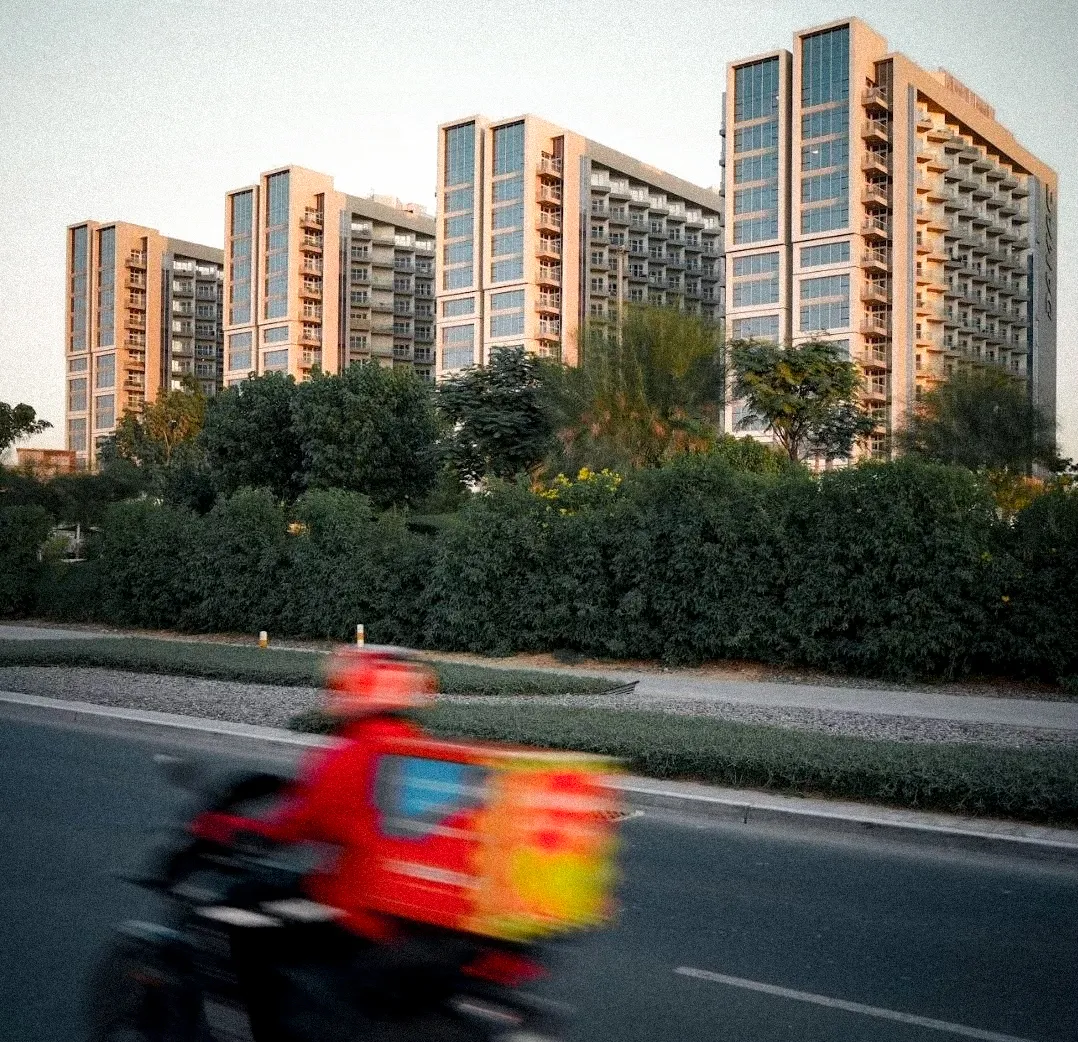

At the dawn of the US-Israeli war on Iran, as missiles largely targeting US-affiliated infrastructure and allied states were being intercepted above Gulf cities, content about delivery workers proliferated as a key category of reactions on social media. This included expressions of gratitude to delivery workers fulfilling orders under fire while residents sheltered at home, as well as content from delivery workers themselves embracing this rise in social media appreciation.
A TikTok posted on 3 March 2026 by marketing channel “Lovin’ Dubai” compiles some of these social media reactions.1 Captioned “Residents are shedding light on delivery heroes who continued working”, the compilation presents its subjects in a formulaic manner. Most videos in the compilation follow a similar style. A gradual zoom-in and pan while the rider is on the go. The clips in the compilation are increasingly distant, capturing only the rider’s side profile or back, branded with their employers’ logos on their uniforms and helmets, without a glimpse of their faces. Under this post, one user comments on the TikTok: “Talabat and UAE air defence is on top 🥹”. Another TikTok posted by user @tetianaskoryna shows over two dozen delivery motorcycles at the entrance of a shopping mall, filmed from behind a window several floors above.2 In the clip, the user writes: “Heroes who never stop working.” Her comment section seems to have gathered reactions from delivery riders, with some identifying themselves in the video: “Silicon central mall and I can even see my self.” Other riders offer more perspective on resuming work despite the circumstances: “we love help to people 🫡 we are not fear bcz if we not working, we not get money,🥹 others sector people will get there absent money.” “Nothing can stop us because we are working hard for our family”, comments a third user.
In a regional economy defined by contingent labour, these posts draw on and reinforce a framing of the gig worker as a hero. Such a framing, while seemingly appreciative, obfuscates the conditions under which these workers are employed and the systems that make this dynamic possible. Gig economy workers — including food delivery riders — labour within economic and technological structures that render them reliant on their jobs regardless of their conditions. As is well documented, gig economy platforms rely on mass unemployment and economic volatility as a form of pressure that leaves workers with little choice but to accept exploitative conditions, job instability, inconsistent pay, and few or no benefits.3 These conditions are compounded for migrant workers, who comprise the entire delivery worker population in Gulf cities. In countries like the UAE, the traditional migrant labour model makes workers entirely dependent on the companies that sponsor their visas. Freelancers, or gig workers, must then rely on freelancing support services for their paperwork. This means that while gig workers seem free to work whenever or wherever they like, they are functionally limited by the same restrictions imposed by employer-sponsored visas. While this work-sponsorship requirement stipulates that workers receive time off and health insurance, it also makes them reliant on intermediary agencies that can impose delivery quotas and offer significantly lower take-home wages than they would otherwise earn.4 The seemingly heroic decision to fulfil orders amid the war is therefore driven by both economic need and immigration policy.
This reality is, conveniently, often missing from viral social media content about delivery riders working through the war, where they faced not only increased security risks and state surveillance but also harder-to-navigate roads as GPS jamming obscured their routes.5 Framing workers’ decision to keep fulfilling orders as a heroic act implicitly sets them up as sacrificable, obscuring the economic, legal, and technological infrastructure shaping their decisions. This phenomenon is not new. During COVID, the term “essential worker” was frequently used across geographic contexts, from the Gulf to the US, to include vulnerable and exploitable labour in the service sector, similarly leaning into heroification to offload moral responsibility and maintain patterns of overconsumption. The term was applied in surprisingly similar ways to both nurses in overcrowded hospitals and delivery workers fulfilling indulgent food orders. The term “essential” became synonymous with expendable, rationalising public acceptance of these workers’ risk and burden.6 Indeed, the essential nature of these workers was purely rhetorical; it did not translate into improvements in material conditions or protections.7
Times of crisis have long shaped society’s understanding of what labour is essential, regardless of the material conditions or compensation for the labourers involved. As the plague spread through Europe, “essential workers” included gravediggers, and during the Spanish Flu, rice farmers. But what is deemed essential is contingent on what is normalised as needed or desired in a given society at a given time. Today, this is informed by the kinds of services modern technological infrastructures condition us to expect and take for granted. The rise of the gig economy created the expectation that at the click of a button, food can be delivered to you — any time, anywhere. This has created a reality where consumers feel as if their lives are at risk if they leave home, yet can still rationalise risking someone else’s life for a delivered meal. Essentialisation and the amplification of easy, idealistic stereotypes are necessary to maintain such a norm.
There is also a long history of labour and production being aestheticised in ways that serve ruling class hegemony and projects of state formation. A contemporary example is analysed in Seth M. Holmes’ embodied anthropology of the US agricultural system.8 Holmes applies Bourdieu’s Symbolic Violence, “[T]he naturalisation, including internalisation, of social asymmetries”, to explain how the dominated come to perceive and accept their position through the very categories imposed by the dominant, misrecognising power relations as natural or inevitable. He argues that, through this process, labour hierarchies are rendered invisible by being represented as a “natural state of affairs”. The exploitation of different migrant ethnic groups is, for instance, justified by bodily aesthetics, such as Mexicans being suitable for farmwork because they are “built lower to the ground”, as he quotes from a 1960s United States senator.
In a geopolitical context where descriptors like “safety” and “stability” are essential pillars of state propaganda, the aesthetics of contingent labour are particularly significant. As Rana AlMutawa documents in the introduction of her urban ethnography of Dubai, a city that often leans into the “spectacular”, the development of essential infrastructure in the city — a hospital, airport, and bank — served an additional aesthetic purpose: “they presented Dubai as a modern place, a safe place, a regulated place”. Sometimes, the optics even moved faster than the provision of the actual essential service. AlMutawa cites a supermarket that, in 1961, had a “Sanitary Inspector” before it could offer fresh milk, prioritising the “optical assurance of hygienic packaging”. The spectacular city has always produced particular legibilities, rendering some things meaningful while foreclosing others. Essential infrastructure is made legible as modernity and safety, obscuring its early shortcomings. The hero narrative operates similarly. The delivery rider’s labour is only legible if portrayed as the work of a selfless hero, while economic precarity that places them in this position is sidelined.
AlMutawa offers additional tools for understanding gig worker heroification. She examines how citizens and residents inhabit this normative mode of spectacle as “adaptive agents” that make these imposed “structures serve their own social needs”, with the caveat that their needs are themselves shaped by the neoliberal development of the spectacular city. Adapting to the hero narrative, riders embrace it, making the best of the short-lived attention that comes in the form of likes and comments. An Instagram user, for instance, who goes by @ProudlySnooner — a reference to the Qatari delivery app Snoonu — posted a reel showing clips of him getting ready to get on his bike, with an emotional soundtrack in the background as he narrates: “While the sky is uncertain, the ground stays united. We ride not just for delivery. We ride for families. We ride for community. We ride for Qatar. Not soldiers, not politicians, just riders serving the people.”9
Between those who film their delivery drivers and the drivers themselves, it is important to consider the increasingly stifled media landscape that amplifies the visibility of this kind of content while suppressing all expressions of dissent.10 In his analysis of political life under fascism, Walter Benjamin argues that Fascism tends towards the aestheticisation of political life, as it seeks to organise the masses without affecting the structure of property relations.11 The fascist state gives the masses the “chance to express themselves” without allowing any change in the property relations that maintain their subjection. The hero narrative is evidently a tool of political deactivation.
Still, drivers’ quest for recognition and their desire to be appreciated and applauded for the risks they take on, and the sacrifices they make, is legitimate and meaningful. We must therefore avoid getting caught in a binary of refusing or accepting this narrative. Nancy Fraser writes that instead of simply endorsing or rejecting such forms of recognition politics, we should take on the intellectual and practical task of developing a critical theory that both accepts the need for recognition — here, appreciation — while simultaneously pursuing a politics of material equality.12
The hero narrative gives certain workers something to be proud of, whether it be delivering orders to fearful residents or braving risks to provide for their families. But an uncritical reading or adoption of this framing risks further devaluing these workers’ labour, pushing rhetoric over material conditions while absolving those who disproportionately benefit from their labour: for profit, for political control, for the veneer of safety and stability.
Notes
-
1. @lovindubai, “Community Heroes: The Unseen Efforts of Delivery Riders”, TikTok, 2 March 2026. https://www.tiktok.com/@lovindubai/video/7612534324168019212.
-
2. @tetianaskoryna, “Heroes Behind Dubai’s Silicon Oasis”, TikTok, 10 March 2026. https://www.tiktok.com/@tetianaskoryna/video/7615590907919731986.
-
3. Jeremias Prassl, Humans as a Service: The Promise and Perils of Work in the Gig Economy, 2018.
-
4. Meaghan Tobin and Roohan Ahmed, “Dubai is a paradise for ‘digital nomads’— and hell for low-wage gig workers”, Rest of World, 27 May 2021.
-
5. Divsha Bhat, “In the Gulf, GPS jamming leaves delivery drivers navigating blind”, Rest of World, 2 April 2026.
-
6. Shan-Estelle Brown and Zoe Pearson. “Human sacrifices, not heroes: US essential workers and the COVID-19 pandemic”, Society for the Anthropology of Work, 2020.
-
7. Katie McQue, “‘I am starving’: the migrant workers abandoned by Dubai employers”, The Guardian, 3 September 2020; Chandan Kumar Mandal, “‘We don’t want to die in this desert’: Nepali workers in the UAE plead to be brought home”, The Kathmandu Post, 16 April 2020.
-
8. Seth M. Holmes and Jorge Ramirez-Lopez, Fresh Fruit, Broken Bodies: Migrant Farmworkers in the United States, 2023.
-
9. @ProudlySnooner, “Even when the sky feels heavy… our hearts stay strong”, Instagram, 1 March 2026. https://www.instagram.com/reel/DVW4Q7Vjfyj.
-
10. Jonathan Dagher, “Censored war: the crackdown on journalists is intensifying from the Gulf to Jordan”, Reporters Without Borders, 11 March 2026.
-
11. Walter Benjamin, Illuminations, 2015.
-
12. Nancy Fraser, “From Redistribution to Recognition? Dilemmas of Justice in a ‘Post-Socialist’ Age”, New Left Review, 1 August 1995.